Why Your Pulp Egg Cartons Won’t Click Shut: The Hidden Role of Mold Precision
Leave a message
As a wholesale buyer or an organic farm owner, few things are more frustrating than a shipment of eco-friendly egg cartons that simply refuse to stay closed. You've made the switch from plastic to sustainable pulp, but now you're facing "lid-pop" issues on the packing line.
Is it the humidity? Is it the material? While environment plays a role, the real culprit is usually hidden in the factory: Mold Precision.
1. The Anatomy of the "Click": Why 0.5mm Matters
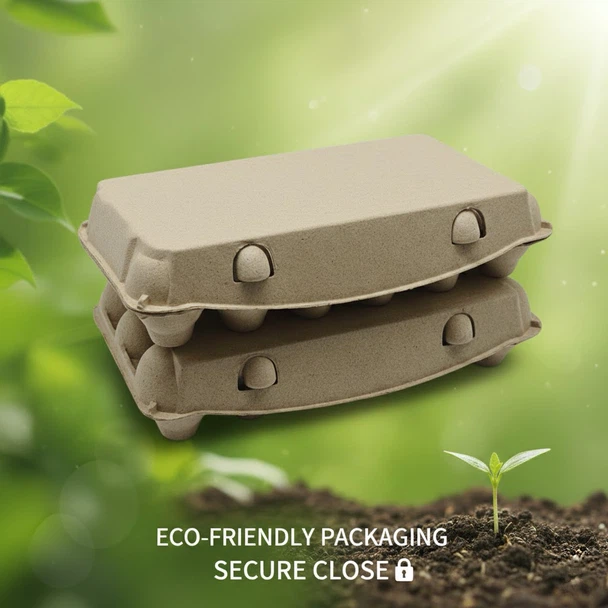
Molded fiber packaging isn't just "pressed paper." It is an engineering feat of vacuum forming. The locking mechanism-those small buttons and holes-relies on a friction fit.
In high-quality manufacturing, the tolerance for these locks is razor-thin. If the CNC-machined mold is off by even 0.5mm, the tension required to keep the lid snapped shut vanishes. When you are processing thousands of eggs an hour, a 2% failure rate in "clasp integrity" leads to massive labor costs in manual re-taping or, worse, damaged goods.
2. Aluminum vs. Plastic Molds: The Durability Gap
One reason you might be experiencing inconsistent quality between batches is the tooling material used by your supplier.
Cheap Plastic/Resin Molds: These are common for low-cost, short-run productions. However, they warp under the heat and pressure of the drying process. A carton from "Cycle 1" will fit perfectly, but a carton from "Cycle 5,000" might be slightly distorted.
High-Precision Aluminum Molds: At Eco-Pack, we utilize aviation-grade aluminum CNC molds. Aluminum dissipates heat evenly and maintains its shape over millions of presses. This ensures that the 10,000th egg carton snaps shut just as securely as the first one.
3. The "Spring-Back" Effect in Plant Fibers
Whether you are using wheat straw pulp, sugarcane bagasse, or recycled paper, every natural fiber has a "memory." After being pressed, fibers tend to relax slightly.
Expert manufacturers account for this "spring-back" during the design phase. If your supplier uses a "one-size-fits-all" mold design for different materials, the lid won't fit. A wheat straw carton requires a slightly different locking geometry than a heavy grey-pulp carton to account for fiber density and stiffness.
4. How to Spot a High-Precision Carton Before You Buy
If you are vetting a new sustainable packaging partner, don't just look at the price. Perform these three "Field Tests" on their samples:
The "Shake Test": Fill the carton with weighted dummy eggs, lock it, and give it a firm vertical shake. A precision-molded clasp should hold under the weight without popping.
The Stack Alignment: Look at a stack of 50 empty cartons. Are they perfectly vertical, or do they lean? A lean indicates uneven wall thickness, a sign of poor mold calibration.
The "Snap" Sound: A high-quality molded fiber carton should produce an audible "click" or "snap." This indicates the friction points are perfectly aligned.
5. Why Precision Equals Profit
For B2B buyers, "cheap" packaging often becomes expensive. A lid that pops open during transit leads to:
Increased insurance claims for broken eggs.
Loss of "Premium" branding (supermarkets won't shelf-stock messy packaging).
Slowed-down automated packing lines.
Conclusion
Eco-friendly shouldn't mean "unreliable." When sourcing wholesale egg cartons, your first question to a manufacturer shouldn't be "How much?" but "How do you maintain your mold precision?"
At Eco-Pack, we bridge the gap between sustainability and industrial-grade reliability. By investing in high-precision CNC tooling and rigorous quality control, we ensure that your brand stays protected-from the farm to the kitchen table.